
Austria World Cup 2026 Squad: Final 26-Player List
Austria last played at a World Cup in 1998. A 28 year wait ends in 2026, and the Austria World Cup 2026 squad arrives carrying the weight of a generation that finally got the job done. Ralf Rangnick has built a team that presses, runs and believes.
Rangnick confirmed his final 26 man squad on May 18, 2026. Austria won UEFA Group H to qualify directly, edging Bosnia and Herzegovina and Romania.
Captain David Alaba leads a roster built around Germany’s Bundesliga and the Red Bull pipeline Rangnick knows so well.
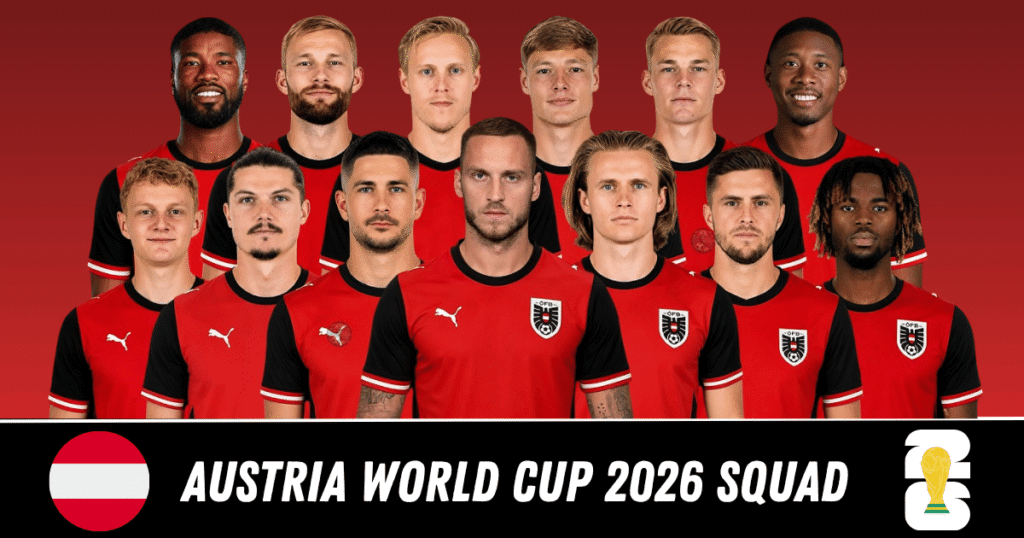
Austria Quick Facts:
- Country: Republic of Austria
- Confederation: UEFA
- Nickname: Das Team
- Head Coach: Ralf Rangnick
- Captain: David Alaba
- Group: Group J
- Group Opponents: Argentina, Algeria, Jordan
- First Match: June 16 vs Jordan, San Francisco Bay Area Stadium, 12:00 AM ET
- Last Group Match: June 27 vs Algeria, Kansas City Stadium, 10:00 PM ET
- World Cup Appearance: Eighth
- Kit Manufacturer: Puma
Austria Squad List for World Cup 2026
Goalkeepers (3)
- Patrick Pentz, 29, Brondby (Denmark)
- Alexander Schlager, 30, Red Bull Salzburg (Austria)
- Florian Wiegele, 25, Viktoria Plzen (Czechia)
Defenders (9)
- David Alaba (C), 33, Real Madrid (Spain)
- Kevin Danso, 27, Tottenham Hotspur (England)
- Marco Friedl, 28, Werder Bremen (Germany)
- Philipp Lienhart, 29, Freiburg (Germany)
- Stefan Posch, 29, Mainz 05 (Germany), on loan from Como
- Phillipp Mwene, 32, Mainz 05 (Germany)
- Alexander Prass, 25, Hoffenheim (Germany)
- David Affengruber, 25, Elche (Spain)
- Michael Svoboda, 27, Venezia (Italy)
Midfielders (11)
- Marcel Sabitzer, 32, Borussia Dortmund (Germany)
- Konrad Laimer, 29, Bayern Munich (Germany)
- Xaver Schlager, 28, RB Leipzig (Germany)
- Nicolas Seiwald, 25, RB Leipzig (Germany)
- Christoph Baumgartner, 26, RB Leipzig (Germany)
- Romano Schmid, 26, Werder Bremen (Germany)
- Patrick Wimmer, 25, Wolfsburg (Germany)
- Florian Grillitsch, 30, Braga (Portugal)
- Alessandro Schopf, 32, Wolfsberger AC (Austria)
- Carney Chukwuemeka, 22, Borussia Dortmund (Germany)
- Paul Wanner, 20, PSV Eindhoven (Netherlands)
Forwards (3)
- Marko Arnautovic, 37, Red Star Belgrade (Serbia)
- Michael Gregoritsch, 32, Augsburg (Germany)
- Sasa Kalajdzic, 28, LASK (Austria)
The age range tells the story. Arnautovic is 37 and Wanner just 20, and Rangnick blended them on purpose. The spine is hardened by players in their late 20s and early 30s who lived through near misses before this breakthrough.
The German league dominates the list. Fourteen of these players turn out in Germany’s Bundesliga, and the Red Bull academies at Salzburg and Leipzig shaped many of them. Only three play in the Austrian league. Rangnick’s national team mirrors the pressing network he helped build.
Fixtures
Austria play all three group stage matches in the United States. Local kickoff times are shown in Eastern Time (ET) and Central European Summer Time (CEST) for fans watching back home.
| Date | Match | Venue | Time (ET) | Time (CEST) |
|---|---|---|---|---|
| June 16, 2026 | Austria vs Jordan | San Francisco Bay Area Stadium, Santa Clara | 12:00 AM | 6:00 AM (+1) |
| June 22, 2026 | Argentina vs Austria | Dallas Stadium, Arlington | 1:00 PM | 7:00 PM |
| June 27, 2026 | Algeria vs Austria | Kansas City Stadium, Kansas City | 10:00 PM | 4:00 AM (+1) |
The top two teams in Group J advance automatically to the Round of 32. The eight best third-placed sides also go through. Argentina are clear favourites to win the group. Austria’s real battle for second runs through Algeria, with Jordan the most winnable fixture.
The schedule is brutal for fans at home. The Jordan opener and the Algeria decider both kick off late at night in the United States, which means the small hours in Austria. Only the Argentina match lands at a sensible evening hour back home.
Manager: Ralf Rangnick
Ralf Rangnick is 67 and German. He took charge of Austria in 2022 and has now delivered the country’s first World Cup in 28 years. His reputation arrived long before he did. Few coaches have shaped modern football as deeply over the past three decades.
He is widely called the godfather of gegenpressing. Rangnick built the Red Bull football model at Salzburg and Leipzig and mentored a generation of coaches. He also had spells at Schalke, Hoffenheim and a short interim run as Manchester United manager in 2022.
His Austria tenure has been a steady climb. The team reached the Euro 2024 knockout stage and then topped a tough qualifying group. Austria won six of eight Group H matches and conceded just four goals. The results matched the project he promised from day one.
Rangnick sets up in a 4-2-3-1 built on aggressive pressing. Austria hunt the ball high, win it back fast and attack quickly. The system demands fitness, and his squad rewards players who can run for 90 minutes. It is a clear, repeatable identity.
Star Player: David Alaba
David Alaba is 33 and plays as a centre-back for Real Madrid. He is Austria’s captain and the most decorated player the country has ever produced. His leadership sits at the centre of Rangnick’s group, and this young team leans on him in big moments.
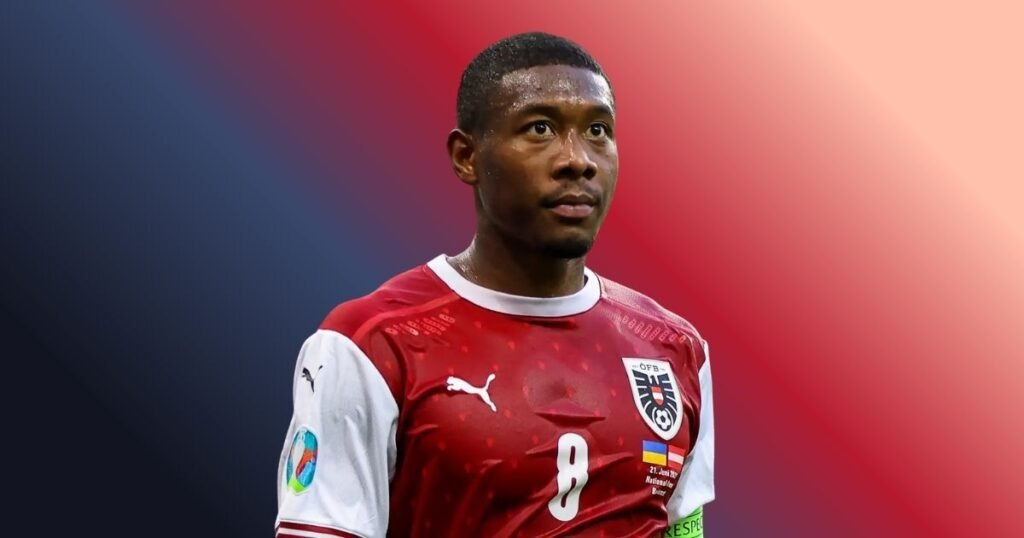
Alaba has earned more than 100 caps for Austria since debuting as a teenager in 2009. He has won the Champions League and league titles with both Bayern Munich and Real Madrid. Few defenders carry that kind of trophy haul into a World Cup.
His versatility is the headline. Alaba began as an attacking left-back, became an elite left-back, then reinvented himself as a centre-back. For Austria he shifts roles to suit the opponent. That flexibility gives Rangnick options no other squad member can match.
Fitness is the one worry. Alaba’s recent Real Madrid seasons were disrupted by injury and his minutes dropped. He arrives fit but with limited club rhythm. Austria need their captain sharp, because his reading of the game shields a back line that lacks pace.
Key Players to Watch
Paul Wanner
Paul Wanner is 20 and the youngest player in Austria’s squad. The attacking midfielder spent the season at PSV Eindhoven. Born in Austria, he came through Germany’s youth ranks before Rangnick convinced him to commit to Das Team. His choice could shape Austria’s next decade.
Wanner is a creative number 10 with quick feet and rare composure for his age. He won’t carry the team yet, but he gives Rangnick a spark off the bench. A talent this raw at a World Cup is exactly the bet Austria are happy to make.
Marko Arnautovic
Marko Arnautovic is 37 and finally gets his World Cup moment. The forward holds Austria’s all-time records for both caps and goals. He plays at Red Star Belgrade now, but his importance to the national team never faded. This stage seems made for him.
He led the line in qualifying and scored eight goals, including four in a 10-0 win over San Marino. Arnautovic is strong with his back to goal and clinical in the box. He gives Austria a focal point few teams in the group can handle.
Marcel Sabitzer
Marcel Sabitzer is 32 and the engine of Austria’s midfield. He plays for Borussia Dortmund and has grown into a leader for club and country. Sabitzer covers ground, drives forward and arrives late in the box. Rangnick trusts him to set the tempo against stronger sides.
His range of passing links the press to the attack. Sabitzer scored in qualifying and added assists across the campaign. Against Argentina’s midfield he’ll face the toughest job of the group stage, and that duel may decide Austria’s fate.
Qualification Path & World Cup History
Austria won UEFA European qualifying Group H to book their place. They played eight matches, won six, drew one and lost one. The only defeat came away to Romania. Austria scored 22 goals and conceded just four, the best defensive record in the group.
The campaign clicked in the autumn. Austria beat Bosnia and Herzegovina home and away, then sealed top spot with a draw against them in November 2025. Bosnia finished second and dropped into the playoffs, while Austria went straight through.
This is Austria’s eighth World Cup, but their first since 1998. Their best run came in 1954, when they finished third in Switzerland. The all-time record across seven previous tournaments reads 12 wins, four draws and 13 defeats from 29 matches.
The 1998 trip to France ended in the group stage with two draws and a defeat. Austria have not won a World Cup match since 1990, when they beat the United States in Italy. Rangnick’s side want to end that long drought.
What to Expect & Our Prediction
Austria will press high and play on the front foot. Rangnick’s 4-2-3-1 is built to suffocate opponents and win the ball in dangerous areas. Their midfield depth is genuine, and set pieces are a real weapon with Arnautovic and Posch both threats.
The weakness is up front beyond Arnautovic. At 37 he can’t start every match at full intensity, and Austria lack a proven second scorer. Defensive pace is another concern, and Algeria’s counter-attacking speed is the matchup that worries Rangnick most.
Jordan are tournament debutants and the game Austria expect to win. Argentina are the reigning champions and clear group favourites. The Algeria match on June 27 looks like the decider for second place and a likely knockout spot.
The realistic prediction is a battle for second behind Argentina. Austria stand a strong chance of finishing as runners-up or sneaking through as one of the best third-placed teams. A Round of 32 spot feels achievable. This forecast reflects the opinion of WCW Staff and not a guaranteed outcome.
Austria World Cup 2026 Squad FAQs
Who is the oldest player in Austria’s 2026 World Cup squad?
Marko Arnautovic is the oldest at 37. The forward holds Austria’s records for most caps and most goals. He plays club football for Red Star Belgrade and led the team’s attack throughout qualifying.
Who is the youngest player in the squad?
Paul Wanner is the youngest at 20. The attacking midfielder plays for PSV Eindhoven. He was born in Austria and represented Germany at youth level before switching his allegiance to the senior Austria team.
How many Austria players are based in Germany’s Bundesliga?
Fourteen of the 26 players are based in Germany’s top flight. The group includes Bayern Munich’s Konrad Laimer and an RB Leipzig trio. Only three players come from the Austrian league.
When did Austria last play at a World Cup?
Austria last appeared at the 1998 World Cup in France. They exited in the group stage with two draws and one defeat. The 2026 tournament ends a 28 year absence and marks their eighth appearance overall.
Which two players switched their national allegiance to Austria?
Carney Chukwuemeka and Paul Wanner both committed to Austria after youth football elsewhere. Chukwuemeka came through England’s setup and Wanner through Germany’s. Rangnick personally worked to convince both to choose Das Team.
What is Austria’s best World Cup result?
Austria’s best result is third place at the 1954 World Cup in Switzerland. That run included a famous 7-5 quarter-final win over the host nation. It remains the high point of Austrian football on the global stage.
The Austria World Cup 2026 squad blends a decorated captain, a record-breaking veteran and a wave of hungry young talent. Rangnick has given this group a clear identity and a belief that 28 years of waiting was worth it. Reaching the knockout rounds is the target, and this team has the tools to chase it.