FIFA World Cup 2026 Records and Stats: Every Milestone Broken
The FIFA World Cup 2026 records confirm this as the most milestone-heavy edition in the tournament’s 96-year history. The first 48-team World Cup ended on July 19 with Spain beating Argentina 1-0 in the final, and it finished with the most goals ever scored, the highest attendance ever recorded, and a new all-time top scorer in Kylian Mbappe.
This page covers every major record and stat from the completed tournament, now updated with the final totals.
The scale explains much of it. With 104 matches instead of 64, and three host nations for the first time, the expanded format produced record numbers both on and off the pitch.
Below are the headline numbers, the records from the final, the player milestones, and the team firsts.
FIFA World Cup 2026 Records: Quick Facts
| Record | 2026 Mark | Previous Record |
|---|---|---|
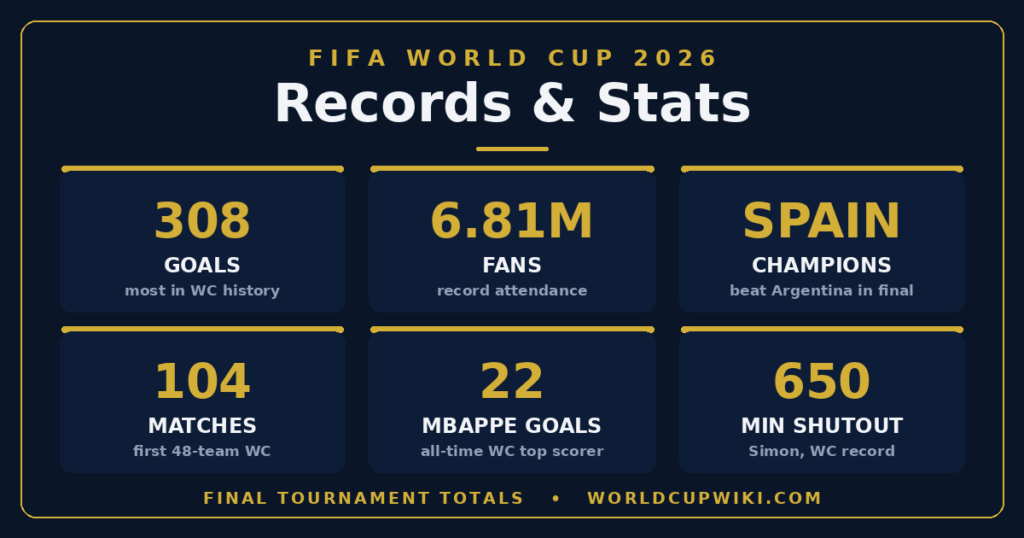
| Champions | Spain, 1-0 vs Argentina (second title) | Argentina, 2022 |
| Goals scored | 308 in 104 matches (most ever) | 172, Qatar 2022 |
| Total attendance | 6,810,966 (most ever) | 3.59 million, USA 1994 |
| Teams | 48 (most ever) | 32 |
| Matches | 104 (most ever) | 64 |
| Host nations | 3, first time shared by three | 1 (usually) |
| All-time top scorer | Kylian Mbappe, 22 World Cup goals | Lionel Messi, 21 (set earlier in 2026) |
| Golden Boot | Kylian Mbappe, 10 goals | Mbappe, 8 (Qatar 2022) |
| Longest clean-sheet streak | Unai Simon, 650 minutes (all-time) | Walter Zenga, 517 (1990) |
Spain’s Title and the Records From the Final
Spain won their second World Cup, and their first since 2010, by beating Argentina 1-0 after extra time at MetLife Stadium on July 19. Ferran Torres scored the only goal in the 106th minute in front of 80,663 fans. Spain also became the first European nation to win a World Cup staged in the Americas, ending a run of seven editions on the continent won by South American teams.
Spain conceded just one goal in eight matches, the tournament’s best defensive record, and stretched their unbeaten run to 38 games. Argentina’s Emiliano Martinez made 11 saves, a record for a World Cup final, but no champion has retained the trophy since Brazil in 1962 and Argentina could not change that. The match also featured the first halftime show in World Cup history.
The individual awards went almost entirely to the champions. Rodri won the Golden Ball, Unai Simon the Golden Glove, and 19-year-old Pau Cubarsi was named Best Young Player, while Mbappe claimed the Golden Boot.
Tournament Records: Goals and Attendance
The 2026 World Cup finished as the highest-scoring edition in history with 308 goals in 104 matches, an average of 2.96 per game, the best scoring rate at a World Cup since Mexico 1970. The record fell early: United States defender Auston Trusty scored the tournament’s 173rd goal against Turkiye in match 59, passing the 172 set across all of Qatar 2022.
Attendance records fell just as fast. According to official FIFA figures, the tournament drew 6,810,966 fans, an average of 65,490 per match at 99.7 percent occupancy, almost double the previous record of about 3.59 million set when the United States last hosted in 1994.
FIFA also logged a single-day record of 426,834 spectators on June 25. The tournament passed another historic landmark when Argentina’s Enzo Fernandez scored the 3,000th goal in men’s World Cup history, in a Round of 16 win over Egypt.
Format Firsts: 48 Teams, 104 Matches, Three Hosts
Several records exist simply because 2026 changed the tournament’s shape. It was the first World Cup with 48 teams, the first with 104 matches, and the first hosted by three nations, the United States, Canada, and Mexico.
The expansion opened the door to debutants and small nations: Curacao, with a population near 150,000, became the smallest country ever to play at a World Cup and the smallest to score, while Cape Verde became the smallest nation to reach the knockout stage. A record nine African teams advanced to the knockout rounds, well beyond the previous best of two.
Player Records and Milestones
Kylian Mbappe left the tournament as the all-time leading scorer in World Cup history. His two goals against England in the third-place match on July 18 took him to 22 career goals, one past Lionel Messi, and his 10 goals in 2026 earned him a second straight Golden Boot after Qatar 2022. He also became France’s most-capped World Cup player, passing Hugo Lloris. Full scorer standings are on our World Cup 2026 Golden Boot page.
Messi still rewrote much of the record book in his final World Cup. He finished with 21 career goals and 8 in 2026, played a record 34 World Cup matches and more minutes than anyone in history, and set a new assists record with 12, passing Pele. He scored in nine consecutive World Cup matches across 2022 and 2026, another record, and became the first player to start three finals.
Other milestones from the tournament:
- Cristiano Ronaldo became the first player to score at six different World Cups and finished as Portugal’s all-time top scorer with 11.
- Jude Bellingham scored seven goals, the most by an England player at a single World Cup, while Harry Kane reached 14 career World Cup goals, England’s all-time record, passing Gary Lineker’s 10.
- Michael Olise set a record for a single edition with seven assists.
- Erling Haaland scored seven times before Norway’s quarterfinal exit, becoming his country’s leading World Cup scorer on his debut.
- Unai Simon set the World Cup record for the longest run without conceding, 650 consecutive minutes across the 2022 and 2026 tournaments, passing Walter Zenga’s 517-minute mark from 1990.
For the first time in World Cup history, four players (Mbappe, Messi, Bellingham, and Haaland) each scored seven or more goals in a single edition.
Team Records
The expanded field produced a run of national firsts. Senegal became the first African nation to score five goals in a match, in a 5-0 win over Iraq, and set an African group-stage record with eight goals. Mexico won four consecutive World Cup matches for the first time, a CONCACAF record.
Japan’s 4-0 win over Tunisia was the 1,000th match in men’s World Cup history and the biggest win by an Asian nation. England’s 6-4 win over France in the third-place match was the first World Cup game with 10 or more goals since 1982 and sealed England’s best finish since winning in 1966.
Bukayo Saka’s hat-trick in that game made him only the second England player to score one in a World Cup knockout match, after Geoff Hurst. The tournament also featured a record five pairs of siblings.
FIFA World Cup 2026 Records FAQ
Who won the FIFA World Cup 2026?
Spain beat Argentina 1-0 after extra time in the final on July 19, 2026, with Ferran Torres scoring in the 106th minute at MetLife Stadium. It was Spain’s second title and the first won by a European team at a World Cup staged in the Americas.
Is the 2026 World Cup the highest-scoring ever?
Yes. It finished with 308 goals in 104 matches, far beyond the previous record of 172 at Qatar 2022, and its average of 2.96 goals per game was the highest at a World Cup since 1970.
Who won the Golden Boot at the 2026 World Cup?
Kylian Mbappe, with 10 goals, his second straight Golden Boot after Qatar 2022. Lionel Messi finished second on 8, with Jude Bellingham and Erling Haaland on 7.
Who is the all-time top scorer in World Cup history now?
Kylian Mbappe, with 22 career World Cup goals. He passed Lionel Messi’s 21 with two goals in the third-place match against England on July 18, 2026.
How many fans attended the 2026 World Cup?
A record 6,810,966 across the 104 matches, an average of 65,490 per game at 99.7 percent stadium occupancy. The previous record was about 3.59 million at USA 1994.
Which goalkeepers set records in 2026?
Spain’s Unai Simon went a record 650 consecutive minutes without conceding across 2022 and 2026 and won the Golden Glove, while Argentina’s Emiliano Martinez made 11 saves in the final, a record for that fixture.
The FIFA World Cup 2026 records close the book on the biggest and most statistically historic tournament ever staged, from the 308 goals and 6.81 million fans to Mbappe’s all-time scoring mark, Spain’s first title won in the Americas, and Messi’s farewell records for matches, minutes, and assists.
Many of these marks are tied to the 48-team format and may stand for years. The next chance to break them comes at the 2030 World Cup across Spain, Portugal, and Morocco.