FIFA World Cup 2026 Sponsors: Complete List of Partners & Supporters
The FIFA World Cup 2026 sponsors represent the most powerful commercial lineup in the history of sport. For the first time 48 teams compete across the United States, Canada and Mexico from June 11 to July 19, 2026 across 104 matches and 16 host cities.
This scale needs massive financial backing. FIFA confirmed in March 2026 that all 16 global sponsorship positions are now filled. It is the first time in World Cup history this happened before a tournament even started. Only two regional spots remain open.
How FIFA World Cup 2026 Sponsors Are Organized
FIFA splits its official partners and commercial supporters into three tiers. Each tier carries different rights and geographic reach.
Tier 1: FIFA Partners hold global rights across all FIFA competitions for the full four-year cycle. These are the most expensive and exclusive positions FIFA offers.
Tier 2: FIFA World Cup 2026 Sponsors hold global rights tied only to the 2026 tournament. Brands at this level typically invest between $65 million and $95 million.
Tier 3: Official Tournament Supporters and Suppliers operate within specific regions or service categories with more limited marketing rights.
Tier 1: FIFA Partners
| Brand | Category | Key Role |
|---|---|---|
| Adidas | Sportswear | Official match balls and team kits |
| Coca-Cola | Beverages | Beverages and World Cup Trophy Tour |
| Hyundai and Kia | Automotive | Official mobility partner |
| Visa | Payment Technology | Official worldwide payment technology |
| Aramco | Energy | Energy sector partner |
| Lenovo | Technology | Official technology partner |
| Qatar Airways | Aviation | Official global airline partner |
Adidas has been a FIFA partner since 1970. The official 2026 match ball is the Trionda, unveiled October 2, 2025. The name combines “Tri” (three) and “Onda” which is Spanish for wave, honoring the three host nations. It uses a four-panel construction with a side-mounted sensor chip that sends real-time ball data to the VAR system. Colors are red for Canada, blue for the USA and green for Mexico. Adidas is the only sporting goods brand in the top-tier lineup.
Coca-Cola joined FIFA in 1978 and operates the FIFA World Cup Trophy Tour. It is projected to visit over 50 countries in the 2026 cycle. Coca-Cola holds exclusive beverage rights meaning Pepsi has no official role in the tournament.
Visa has been FIFA’s payment technology partner since 2007. Visa cardholders got exclusive presale access during the first ticket sales window.
Hyundai and Kia renewed through 2030. Their vehicles serve teams, officials and media across all 16 host cities.
Qatar Airways renewed as global airline partner through 2030. It shares the North American air travel category with American Airlines under a new regional arrangement.
Aramco holds its deal through 2027 and uses the World Cup’s global reach to build recognition across multiple regions.
Lenovo is the official technology partner for 2026 and the 2027 Women’s World Cup. Key tools include Football AI Pro, a generative AI assistant for all 48 teams, and 3D player avatar scanning that powers the semi-automated offside system.
Tier 2: FIFA World Cup 2026 Official Sponsors
| Brand | Category | Key Role |
|---|---|---|
| AB InBev (Budweiser / Michelob Ultra) | Beverages | Official beer of the 2026 World Cup |
| Bank of America | Banking | FIFA’s first-ever global banking sponsor |
| Frito-Lay (Lay’s) | Snack Food | Official snack food sponsor |
| Hisense | Consumer Electronics | Display technology and broadcast quality |
| McDonald’s | Quick Service Restaurants | Official food service partner |
| Mengniu Dairy | Dairy / Food | Chinese dairy company, Asian market focus |
| Unilever (Dove Men+Care) | Personal Care | Personal care products |
| Verizon | Telecommunications | Official telecommunications sponsor |
| DoorDash | On-Demand Delivery | Official on-demand delivery and restaurant reservations |
AB InBev has worked with FIFA for nearly 40 years. Michelob Ultra is the official beer of the 2026 World Cup and created the Superior Player of the Match trophy. It gets awarded after every one of the 104 matches through fan votes. Lionel Messi features in the campaign to unveil it.
Bank of America became FIFA’s first-ever global banking sponsor in August 2024. FIFA president Gianni Infantino called the deal “pioneering.” It is also the largest sports investment Bank of America has ever made.
Frito-Lay (Lay’s) runs the “No Lay’s, No Game” campaign featuring Lionel Messi, David Beckham, Thierry Henry, Alexia Putellas and Steve Carell in a watch party concept built around a WhatsApp group.
Hisense signed on in September 2025 marking its fourth consecutive World Cup since 2018. The brand focuses on display technology and HDR broadcast quality.
McDonald’s has partnered with FIFA since 1994 and renewed through the 2030 World Cup.
Verizon became the Official Telecommunication Services Sponsor in September 2024 covering network and stadium operations across all 11 US host cities.
DoorDash holds two firsts at any FIFA tournament. It is the first-ever Official On-Demand Delivery Supporter and the first-ever Official Restaurant Reservations Platform Supporter. The deal covers nine countries through its DoorDash, Deliveroo and Wolt brands.
Tier 3: Official Tournament Supporters and Suppliers
| Brand | Category | Key Role |
|---|---|---|
| Airbnb | Accommodation | Official accommodation supporter in North America |
| American Airlines | Aviation | Official North American airline supplier |
| Boggi Milano | Formalwear | Official formalwear outfitter for FIFA workforce |
| Diageo | Spirits | Official spirits supporter in the Americas |
| Fanatics | Retail and E-commerce | Exclusive retail rights across all three host nations |
| Globant | Technology Services | Official technology services supporter |
| The Home Depot | Home Improvement Retail | Official home improvement retail supporter in North America |
| Marriott Bonvoy | Hotels | Official hotel supporter in North America |
| Rock-it Cargo | Logistics | Official logistics provider |
| Valvoline | Automotive Services | Official supporter |
Airbnb is the official accommodation supporter in North America. Over 380,000 guests are expected to use Airbnb properties during the tournament. Deloitte projects a $3.6 billion economic boost tied to Airbnb usage across host communities.
American Airlines joined as the official North American airline supplier in April 2025. The carrier runs more than 2,200 daily flights to World Cup host cities alongside Qatar Airways.
Boggi Milano signed a four-year partnership as the official formalwear outfitter covering the 2026 World Cup and 2027 Women’s World Cup. The Italian brand was founded in 1939 and has 290 stores in over 60 countries. It outfits the entire FIFA workforce including Council members and also launched a licensed capsule collection.
Fanatics holds exclusive retail rights across the United States, Canada and Mexico for all 104 matches including stadium stores, fan festivals, pop-ups and e-commerce.
Marriott Bonvoy joined as the official hotel supporter in North America in January 2026. The deal covers 30-plus hotel brands at approximately $15 million.
Diageo covers the official spirits category across North, Central and South America through Johnnie Walker and Smirnoff.
Valvoline marks its 160th anniversary in 2026 with its first major global sporting event partnership.
- You can also check the full World Cup fixtures.
What is New Among FIFA World Cup 2026 Sponsors
Several 2026 tournament sponsors and brand partners set records that never happened at any previous World Cup.
Bank of America is FIFA’s first-ever global banking sponsor. DoorDash is the first-ever Official Restaurant Reservations Platform Supporter at any FIFA event. Boggi Milano is the first fashion house to outfit the FIFA workforce. Fanatics runs the first centralized retail operation across all three host nations.
American Airlines and Qatar Airways now share the North American airline category. FIFA’s previous exclusivity rules blocked this. FIFA changed its model for 2026 to allow regional category sharing.
For the first time each of the 16 host cities can sell their own regional sponsorships. Ontario Power Generation joined Toronto as the first official Host City Supporter. Nestlé Purina PetCare signed with Kansas City and NAPA Auto Parts with Atlanta.
How Much FIFA Earns from World Cup 2026 Sponsors
| Revenue Stream | Amount |
|---|---|
| Total 2023-2026 FIFA cycle revenue (projected) | $11 billion |
| 2026 World Cup share | $8.9 billion |
| Broadcasting rights | $3.92 billion |
| Ticket sales and hospitality | $3.097 billion |
| Marketing and sponsorship | $2.693 billion |
| Sponsorship revenue increase vs 2022 | $927 million more |
| Total projected sponsorship revenue | $2.5 to $3 billion |
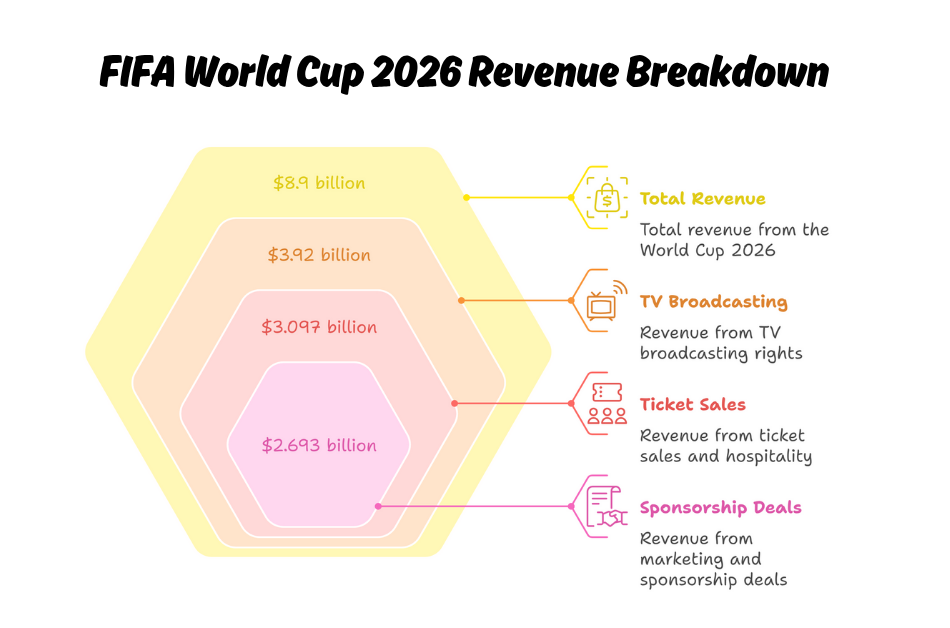
The 2026 World Cup already generated more sponsorship funding than any previous standalone sporting event before a match was played. FIFA Chief Business Officer Romy Gai confirmed this at The Business of Soccer Conference in Atlanta on March 27, 2026.
FIFA puts these earnings back into football development through its FIFA Forward 3.0 programme. Each of the 211 member associations receives $1.5 million to grow the sport in their region.
How Sponsors Shape the Fan Experience
Sponsorships do more than put logos on pitch-side boards. Every tier contributes something fans actually see and use.
Adidas puts the match ball in play. Visa processes every ticket purchase and stadium transaction. Lenovo powers the offside technology fans see reviewed on screens. Hisense shapes the picture quality at home and at fan zones. American Airlines and Airbnb get international fans to host cities. The Home Depot upgraded stadium facilities. Rock-it Cargo moves the equipment that keeps the tournament running. Fanatics runs every retail store inside stadiums and fan festivals.
All 16 host cities will have official FIFA Fan Festivals with free entry. Sponsors fund live screenings, interactive zones and entertainment for fans without match tickets. The FIFA World Cup 2026 sponsors and official partners make the full fan experience possible from the opening match on June 11 to the Final on July 19.
FIFA World Cup 2026 Sponsors FAQs
Who is the official beer sponsor of the 2026 World Cup?
Michelob Ultra is the official beer of the FIFA World Cup 2026. It is part of AB InBev which also owns Budweiser. The brand created the Superior Player of the Match trophy awarded after every game this tournament.
Is Nike a sponsor of the 2026 World Cup?
No. Nike is not an official FIFA sponsor for 2026. Adidas holds the exclusive sportswear rights as a top-tier FIFA Partner. Nike does supply kits for several national teams including Brazil, England and Portugal but has no official tournament sponsorship.
Is Pepsi a sponsor of the 2026 World Cup?
No. Coca-Cola holds exclusive category rights as a top-tier FIFA Partner since 1978. Pepsi has no official role at the 2026 World Cup.
Who makes the official match ball for the 2026 World Cup?
Adidas makes the official match ball. It is called the Trionda, introduced on October 2, 2025. The name means “three waves” in Spanish representing the three host nations. It uses a four-panel design with a built-in motion sensor chip that supports VAR offside decisions in real time.
How many official sponsors does the 2026 World Cup have?
Seven top-tier FIFA Partners, nine FIFA World Cup 2026 Sponsors and over 10 Official Tournament Supporters and Suppliers. All 16 global sponsorship positions are sold out as confirmed by FIFA in March 2026.
How much does it cost to sponsor the 2026 World Cup?
Tier 2 sponsors typically invest between $65 million and $95 million. Top-tier FIFA Partners invest significantly more. The Marriott Bonvoy regional deal was reported at approximately $15 million.
What brands are not allowed to advertise at the 2026 World Cup?
FIFA enforces strict clean zone policies around all stadiums. Competing brands in exclusive categories cannot advertise near venues. Pepsi cannot activate near stadiums because Coca-Cola owns the beverage category. Nike cannot run official activations inside venues because Adidas holds sportswear rights. Non-sponsor brands use creative workarounds outside clean zones.