2030 World Cup: Host Countries, Dates, and Format
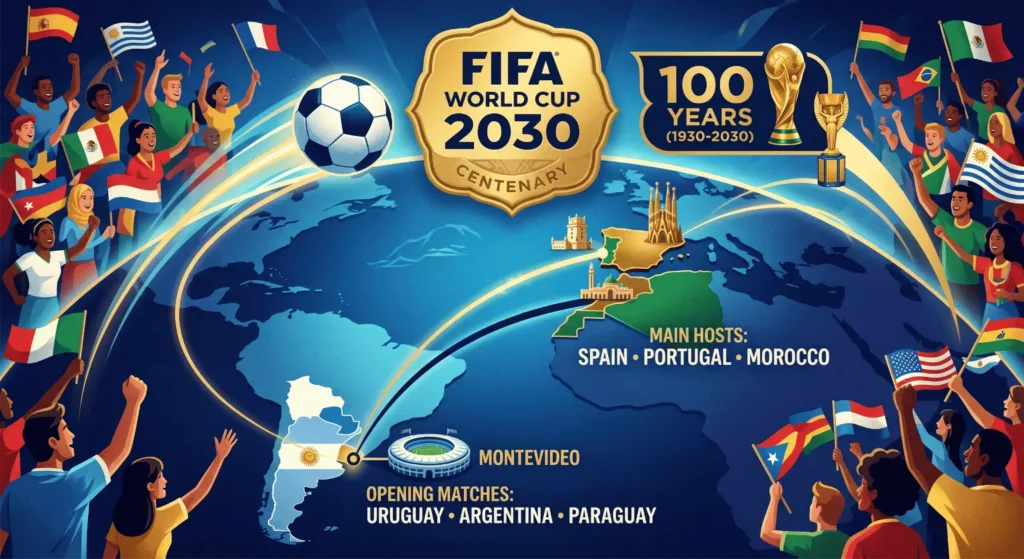
The 2030 World Cup is the next edition of the tournament after 2026, and it will be unlike any before it. As the centenary World Cup, marking 100 years since the first tournament in 1930, it is hosted mainly by Morocco, Portugal, and Spain, with three opening matches staged in South America. That makes it the first World Cup ever spread across six countries and three continents.
This page covers where the 2030 World Cup is held, when it takes place, its format, and the historic firsts it will set.
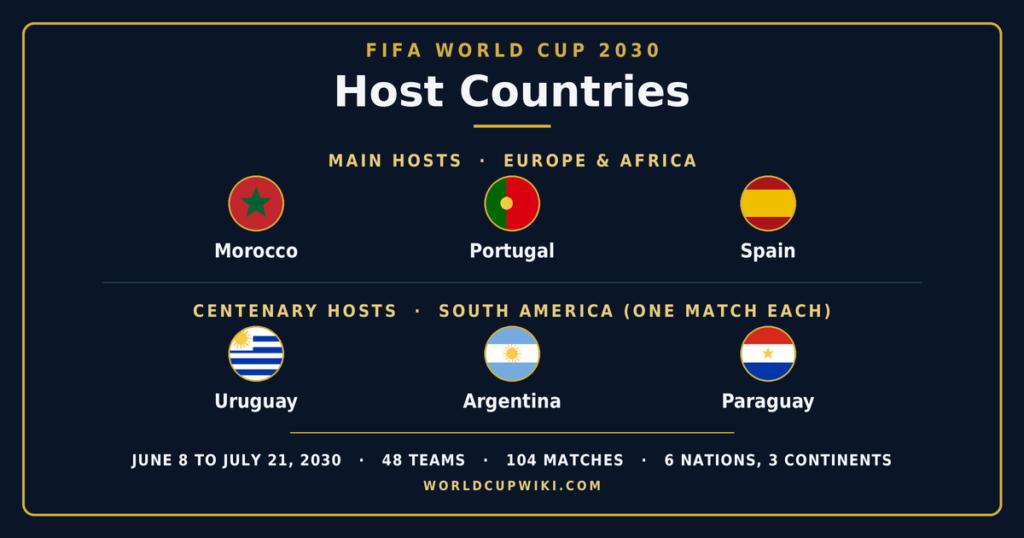
FIFA confirmed the hosts at an Extraordinary Congress on December 11, 2024. The tournament keeps the 48-team, 104-match format introduced in 2026.
2030 FIFA World Cup: Quick Facts
| Edition | 24th FIFA World Cup (centenary) |
| Main hosts | Morocco, Portugal, Spain |
| Centenary hosts | Uruguay, Argentina, Paraguay (one match each) |
| Dates | June 8 to July 21, 2030 (provisional) |
| Teams | 48 |
| Matches | 104 |
| Final venue | To be confirmed (decision expected in 2026) |
| Confirmed by FIFA | December 11, 2024 |
Where is the 2030 World Cup Held?
The 2030 World Cup is hosted mainly by three nations: Morocco, Portugal, and Spain. They stage the group stage, the knockout rounds, and the final, which is 101 of the 104 matches in total. Spain and Portugal share a land border, and Morocco sits just across the Strait of Gibraltar, which keeps the main tournament geographically compact despite spanning two continents.
The other three matches open the tournament in South America, one each in Uruguay, Argentina, and Paraguay.
Why Three Opening Matches in South America?
The first World Cup was held in Uruguay in 1930, and Uruguay won it. To honour that centenary, FIFA awarded three celebration matches to South America before the tournament moves to Europe and Africa.
The opening match returns to the Estadio Centenario in Montevideo, the stadium that hosted the 1930 final. Argentina, the 1930 runner-up, hosts a match at the Estadio Monumental in Buenos Aires, and Paraguay, home of the confederation CONMEBOL, hosts the third at the Estadio Osvaldo Dominguez Dibb in Asuncion.
Teams then travel to the Spain, Portugal, and Morocco corridor for the rest of the competition.
2030 World Cup Dates and Schedule
The 2030 World Cup is expected to run from June 8 to July 21, 2030, a span of about 44 days that would make it the longest World Cup ever, stretched by the multi-continental travel for the centenary.
The three South American matches open the tournament on June 8 and 9, a few days before the main schedule begins in Europe and Africa.
These dates follow FIFA’s current planning framework and will be finalised closer to the event, with the full calendar published after the qualifying draw. Qualification for most confederations runs from 2027 through 2029.
Format and Qualification
Teams are drawn into 12 groups of four, and the top two from each group plus the eight best third-placed teams advance to a 32-team knockout bracket that ends with the final.
Six places are already filled: the three main hosts and the three centenary hosts all qualify automatically, while every other nation reaches the finals through its confederation’s qualifying.
A one-off expansion to 64 teams has been proposed to mark the centenary, and FIFA president Gianni Infantino said in 2026 that he would consider it, but it has not been adopted, so the format stays at 48 teams.
2030 World Cup Final Venue and Stadiums
FIFA has not yet chosen the stadium for the July 21, 2030 final. Three venues lead the race: the Santiago Bernabeu in Madrid, Camp Nou in Barcelona, and the Grand Stade Hassan II near Casablanca, with a decision expected around the end of 2026.
The Grand Stade Hassan II is the standout. Planned at 115,000 seats and still under construction, it is on track to become the largest football stadium in the world.
The wider list of about 20 stadiums across 17 cities remains a bid proposal awaiting final FIFA approval, and it has already shifted: Malaga and A Coruna withdrew from the Spanish list, with Valencia and Vigo proposed as replacements.
Historic Firsts
The 2030 World Cup sets several records before a ball is kicked. It is the first held across six host nations, three continents, and more than one confederation.
It is the first in Africa since 2010 and the first ever in North Africa, through Morocco, as well as the first in Spain since 1982, the first in Uruguay since 1930, the first in Argentina since 1978, and the first ever staged in Portugal and Paraguay.
At about 44 days, it is also set to be the longest World Cup in history. The tournament after it, the 2034 World Cup, is set for Saudi Arabia.
2030 FIFA World Cup FAQ
How many countries are hosting the 2030 World Cup?
Six, across three continents, the first World Cup spread across six nations. Spain, Portugal, and Morocco host the main tournament, while Uruguay, Argentina, and Paraguay each host one centenary match.
When is the 2030 World Cup?
It is expected to run from June 8 to July 21, 2030. These dates follow FIFA’s planning framework and will be confirmed closer to the tournament.
Why does the 2030 World Cup start in South America?
Because 2030 marks 100 years since the first World Cup, held in Uruguay in 1930. FIFA awarded three centenary matches to Uruguay, Argentina, and Paraguay, with the opener at the Estadio Centenario in Montevideo, home of the 1930 final.
How many teams play in the 2030 World Cup?
Forty-eight, playing 104 matches in total. All six host nations qualify automatically, and every other team qualifies through its confederation.
Where will the 2030 World Cup final be held?
The venue is not yet confirmed. The Santiago Bernabeu, Camp Nou, and the Grand Stade Hassan II are the leading candidates, with FIFA expected to decide around the end of 2026.
Where is the next World Cup after 2030?
Saudi Arabia will host the 2034 FIFA World Cup as a single host nation, confirmed by FIFA on the same day as the 2030 hosts.
The 2030 World Cup will be the most geographically ambitious tournament in the sport’s history, opening in South America to honour the 1930 centenary before its main stage across Morocco, Portugal, and Spain.
The hosts are confirmed and six nations have already qualified, so the biggest decision still pending is the venue for the July 21 final.
For the full list of past champions, see our World Cup winners list. This page will be updated as the 2030 World Cup host cities and schedule are finalised.