
FIFA World Cup 2026 Simulator: Predict All 104 Matches
The FIFA World Cup 2026 simulator is an interactive tool that models the entire tournament, from the group stage through the final at MetLife Stadium. It covers all 48 teams, 12 groups, and 104 matches of the first 48-nation World Cup, allowing match winners to be selected by hand or generated automatically from FIFA rankings. The result is a complete, shareable bracket that follows the official tournament format.
The 2026 edition is the largest in World Cup history. It runs from June 11 to July 19, 2026, across 16 venues in the United States, Canada, and Mexico.
The expanded structure introduced a new Round of 32 knockout stage, and the simulator reflects that format exactly, including the rule that sends the eight best third-place teams into the knockout bracket.
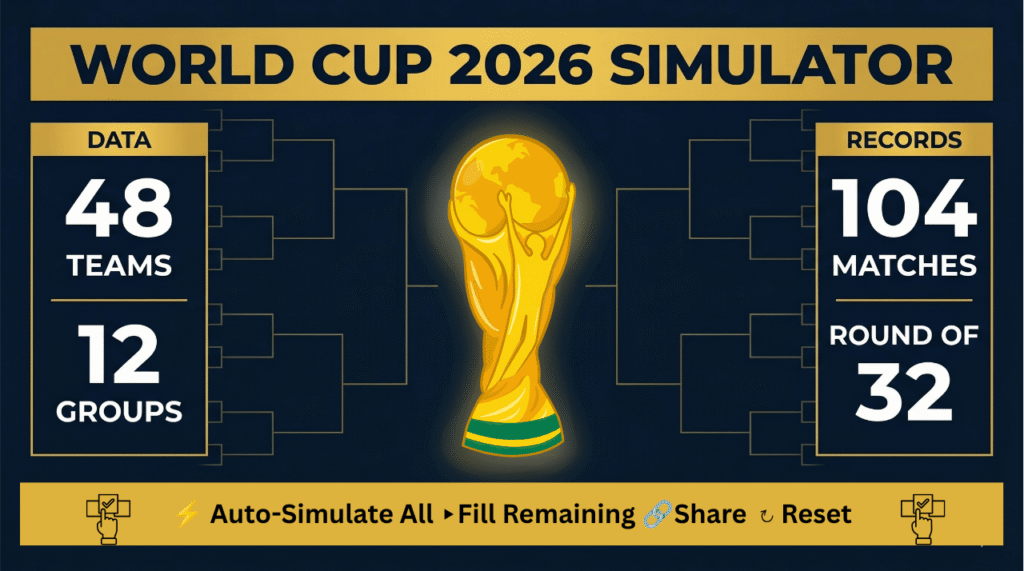
FIFA World Cup 2026 Simulator Quick Facts
| Tournament | FIFA World Cup 2026 |
| Teams | 48 |
| Groups | 12 (Groups A to L) |
| Total matches | 104 |
| Group stage matches | 72 |
| Knockout matches | 32 |
| Knockout format | Round of 32, Round of 16, Quarterfinals, Semifinals, Final |
| Qualifying teams | Top 2 per group plus 8 best third-place teams |
| Tournament dates | June 11 to July 19, 2026 |
| Opening match venue | Estadio Azteca (Mexico City Stadium), Mexico City |
| Final venue | MetLife Stadium, East Rutherford, New Jersey |
| Final date | July 19, 2026 |
| Host nations | United States, Canada, Mexico |
World Cup 2026 Simulator
Predict all 104 matches of the FIFA World Cup 2026. Pick winners group by group, or auto-simulate the full tournament using FIFA rankings.
How the FIFA World Cup 2026 Simulator Works
The simulator is built around two stages that mirror the real tournament. The group stage presents all 12 groups and their 72 matches with live standings, where each group plays a single round-robin and the top two teams advance directly to the Round of 32. Once every group result is set, the knockout bracket unlocks and runs as single-elimination through the Round of 32, Round of 16, quarterfinals, and semifinals before the final.
There are three ways to complete the tournament. Manual selection chooses a winner or a draw for each match, with standings updating instantly using the official tiebreakers. Automatic simulation fills every match using FIFA rankings and a weighted probability model, then crowns a champion.
A third option fills only the matches that remain undecided, which preserves any picks already made. Each group match also displays a small probability indicator based on team strength, so the favorite in any fixture is visible before a pick is made.
Also Check: Printable & Fillable FIFA World Cup 2026 Bracket
How the Best Third-Place Teams Are Determined
The 2026 format adds a layer that did not exist in the 32-team era. After the top two from each group qualify, the third-place finishers from all 12 groups are compared against one another, and the eight best advance to complete the 32-team knockout bracket. Four third-place teams are eliminated.
The simulator ranks the twelve third-place teams using the following order, applied in sequence whenever teams are level:
- Points
- Goal difference
- Goals scored
- FIFA ranking
The first three are the official FIFA criteria for comparing third-place teams. The fourth, FIFA ranking, serves as the simulator’s deterministic tiebreaker in place of the fair-play and drawing-of-lots rules used at the real tournament, which cannot be modeled in a prediction tool.
A dedicated section in the simulator lists all twelve third-place teams in ranked order, with a clear cutoff line after the eighth position so that the qualifiers and the eliminated teams are easy to identify.
Because the destination of each third-place team depends on which specific groups they came from, two simulations that send the same eight thirds through can still produce different Round of 32 matchups, reflecting the genuine complexity of the 2026 draw.
Auto-Simulation and the Strength Model
The automatic mode uses the official FIFA rankings published on April 1, 2026, converted into a team strength value. The probability that a team wins a given match scales with the gap in strength between the two sides. Group matches also allow for draws, with the likelihood of a draw decreasing as the gap in strength widens.
The model is intentionally calibrated to favor stronger teams without making outcomes certain. Top-ranked nations such as France, Spain, and Argentina win the simulated tournament most often, but lower-ranked teams still break through often enough to produce a different story on each run.
Once a bracket is complete, a single share action copies a link containing every pick, so any prediction can be compared with others or revisited later.
FIFA World Cup 2026 Simulator FAQ
How are the best third-place teams ranked?
The twelve third-place teams are compared by points, then goal difference, then goals scored, and finally FIFA ranking. The eight highest-ranked thirds advance to the Round of 32, and the bottom four are eliminated.
Does the simulator follow the official tournament format?
Yes. It reflects the 48-team structure, the new Round of 32 stage, and the predetermined knockout paths set out in FIFA’s tournament regulations, including how third-place teams are assigned to specific matches.
Can a completed bracket be shared?
Yes. A share action generates a link that stores every pick. Opening that link reproduces the exact bracket, which allows predictions to be compared or revisited later.
Which teams are favored to win the 2026 World Cup?
In the simulator’s model, the highest-ranked nations such as France, Spain, and Argentina win most often, since match probabilities are weighted by FIFA rankings. Lower-ranked teams still advance regularly, so no outcome is guaranteed.
How accurate is the World Cup 2026 simulator?
The tool is a prediction model, not a forecast of guaranteed results. It uses real FIFA rankings and a weighted probability system to produce realistic outcomes, but football results are unpredictable, and the simulator is designed to reflect that uncertainty.
The FIFA World Cup 2026 simulator covers all 48 teams, 12 groups, and 104 matches in one interactive tool. Results can be chosen by hand or generated from FIFA rankings, and every complete bracket can be shared with a single link.