Ivory Coast World Cup 2026 Squad: Final 26-Player List
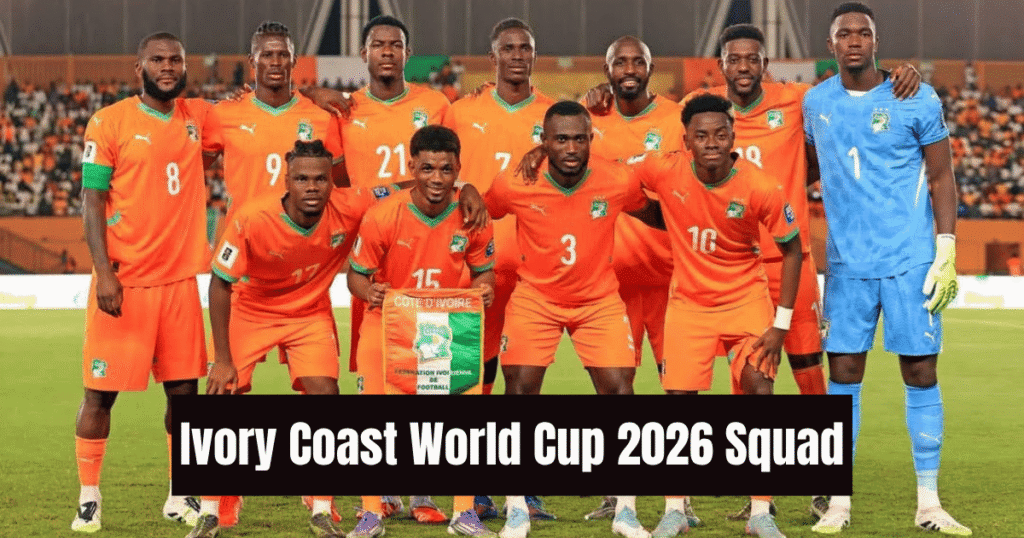
Côte d’Ivoire are back at the World Cup after a 12-year absence. Head coach Emerse Faé announced the Ivory Coast World Cup 2026 squad of 26 players on May 15, 2026, and Les Éléphants will make their fourth FIFA World Cup appearance in the United States, Mexico, and Canada. The reigning African champions have qualified for the first time since 2014, arriving with a young and ambitious group that doesn’t lack for firepower.
Faé’s selection mixes Premier League stars with experienced campaigners and a handful of players looking to make their biggest stage debut. Captain Franck Kessié reached 100 international caps earlier in 2026, and the squad built around him has the talent to spring a surprise or two in Group E.
Sébastien Haller, the hero of the 2024 Africa Cup of Nations, did not make the cut. The attacking burden falls on Amad Diallo and a fresh generation of Ivorian forwards.
Côte d’Ivoire Quick Facts:
- Country: Côte d’Ivoire (Ivory Coast)
- Confederation: CAF
- Nickname: Les Éléphants (The Elephants)
- Head Coach: Emerse Faé
- Captain: Franck Kessié
- Group: Group E
- Group Opponents: Germany, Ecuador, Curaçao
- First Match: June 14 vs Ecuador, Philadelphia Stadium, 7:00 PM ET
- Last Group Match: June 25 vs Curaçao, Philadelphia Stadium, 4:00 PM ET
- FIFA Ranking: 34th as of April 1, 2026
- World Cup Appearance: Fourth
- Kit Manufacturer: Puma
Ivory Coast Squad List for World Cup 2026
Emerse Faé’s final Ivory Coast World Cup 2026 squad spans nine countries and four confederations. The 26 players include three goalkeepers, eight defenders, eight midfielders, and seven forwards, with Franck Kessié leading the group as captain.
Goalkeepers
- Yahia Fofana, 29, Çaykur Rizespor (Turkey)
- Mohamed Koné, 23, Royal Charleroi SC (Belgium)
- Alban Lafont, 27, Panathinaikos (Greece)
Defenders
- Emmanuel Agbadou, 26, Beşiktaş (Turkey)
- Clément Akpa, 23, AJ Auxerre (France)
- Ousmane Diomandé, 22, Sporting CP (Portugal)
- Guéla Doué, 20, RC Strasbourg (France)
- Ghislain Konan, 29, Gil Vicente (Portugal)
- Odilon Kossounou, 25, Atalanta (Italy)
- Evan Ndicka, 26, AS Roma (Italy)
- Wilfried Singo, 23, Galatasaray (Turkey)
Midfielders
- Franck Kessié (C), 29, Al-Ahli (Saudi Arabia)
- Ibrahim Sangaré, 27, Nottingham Forest (England)
- Seko Fofana, 31, FC Porto (Portugal, on loan from Stade Rennais)
- Jean-Michaël Seri, 34, NK Maribor (Slovenia)
- Christ Inao Oulaï, 26, Trabzonspor (Turkey)
- Parfait Guiagon, 25, Sporting Charleroi (Belgium)
- Simon Adingra, 24, AS Monaco (France, on loan from Sunderland)
- Yan Diomandé, 19, RB Leipzig (Germany)
Forwards
- Amad Diallo, 23, Manchester United (England)
- Evann Guessand, 24, Crystal Palace (England, on loan from Aston Villa)
- Ange-Yoan Bonny, 22, Inter Milan (Italy)
- Nicolas Pépé, 31, Villarreal CF (Spain)
- Elye Wahi, 22, OGC Nice (France, on loan from Eintracht Frankfurt)
- Oumar Diakité, 22, Cercle Brugge (Belgium, on loan from Stade de Reims)
- Bazoumana Touré, 20, TSG Hoffenheim (Germany)
The squad has a clear generational split. Veteran presences such as Seko Fofana (31), Jean-Michaël Seri (34), and Nicolas Pépé (31) sit alongside teenagers and early-20s players making their first World Cup appearance.
Evan Ndicka, Odilon Kossounou, and Ousmane Diomandé form one of CAF’s stronger centre-back pools. Yan Diomandé, at 19, is the youngest player called up and comes into the tournament riding some serious Bundesliga momentum.
The league spread reflects Ivory Coast’s diaspora ties to France and beyond. Seven players are based in England, five in France, and another five across Turkey’s top flight. The Ivorian federation has long cast its net wide. Ange-Yoan Bonny and Evan Ndicka are both French-born players who chose the Elephants. That pattern gives Faé real depth at every position.
Fixtures
Côte d’Ivoire play all three group stage matches across the United States and Canada. Local kick-off times are listed in both Eastern Time (ET) for North American host venues and GMT for fans watching in Ivory Coast.
| Date | Match | Venue | Time (ET) | Time (GMT) |
|---|---|---|---|---|
| June 14, 2026 | Ivory Coast vs Ecuador | Philadelphia Stadium, Philadelphia | 7:00 PM | 11:00 PM |
| June 20, 2026 | Ivory Coast vs Germany | Toronto Stadium, Toronto | 4:00 PM | 8:00 PM |
| June 25, 2026 | Ivory Coast vs Curaçao | Philadelphia Stadium, Philadelphia | 4:00 PM | 8:00 PM |
The top two teams from Group E advance to the Round of 32, as do the eight best third-placed teams across all 12 groups. That means Ivory Coast don’t necessarily need to finish second to stay in the tournament, though Faé’s side will be aiming for nothing less than a top-two spot.
The opener against Ecuador is the match that will likely define Ivory Coast’s tournament. Germany is the group favourite and will be a stern test on June 20. The final game against Curaçao in Philadelphia should be the most manageable, but football has a way of making the “easy” game the most stressful one.
Manager: Emerse Faé
Emerse Faé was born on January 24, 1984, in France and is 42 years old. He is one of the more unusual managerial stories at this World Cup. He played as a defensive midfielder for Nantes, Reading, and OGC Nice, but blood clots forced him into retirement at just 28. His coaching journey started quietly at Nice’s academy in 2012.
Faé moved into international football in May 2022 as Ivory Coast’s U23 head coach and Gasset’s senior assistant. He got the interim call on January 25, 2024, after Gasset resigned mid-tournament at the Africa Cup of Nations with the Elephants close to elimination. Faé then guided them all the way to the title, beating Nigeria 2-1 in the final on home soil. The federation made him permanent shortly after.
His preferred system is a 4-3-3 built on a defensive mid-block that transitions quickly into attack. Faé trusts his wide forwards to carry the ball at pace in transition and asks his midfield trio to stay compact and cover the spaces behind. The system is not flashy, but it works. Ivory Coast conceded very little during qualification.
Star Player: Franck Kessié
Franck Kessié was born on December 19, 1996, and is 29 years old. He plays as a central midfielder for Al-Ahli in the Saudi Pro League and is the captain of the Ivory Coast national team. Kessié is the kind of midfielder who does the unglamorous work with real authority. He wins second balls, drives into the box, and delivers on set pieces when it matters most.
Kessié made his international debut in 2014 and has gone on to earn more than 100 caps, becoming the most-capped player in this Ivory Coast squad. He lifted the AFCON trophy as captain on home soil in 2024, scoring the equalizer against Nigeria in the final before Sébastien Haller grabbed the winner. Captaining your country to a continental title on home soil is about as good as it gets in African football.
His club career took him through Atalanta and a decorated stint at AC Milan, where he won Serie A and built a reputation as one of Europe’s best box-to-box midfielders. After a spell at Barcelona, he moved to Al-Ahli in Saudi Arabia and has remained sharp. His AFCON title as captain is a remarkable achievement, and a World Cup run is the obvious next ambition.
At this tournament, Kessié is the engine that makes Ivory Coast’s system work. He sits behind the attack, protects the defence, and organises the press trigger. If the Elephants are to advance from Group E, they need him fit and at his commanding best. His leadership quality is something this squad cannot replicate anywhere else.
Key Players to Watch
Yan Diomandé
Born on November 14, 2006, Yan Diomandé is just 19 years old and the youngest player in the Ivory Coast squad. He plays as a winger for RB Leipzig in the Bundesliga and has been one of the most exciting young attackers in German football this season. His direct running and ability to beat his man in tight spaces have drawn serious transfer interest from top clubs across Europe.
Diomandé represents the exciting next wave of Ivorian talent. At 19, this World Cup is likely his first of several, and his pace and willingness to take on defenders make him a real weapon in Faé’s transition-heavy system. The bigger the stage, the more relaxed he seems to play. For someone his age, that composure is genuinely rare.
Ibrahim Sangaré
Ibrahim Sangaré was born on June 27, 1998, and is 27 years old. He plays as a defensive midfielder for Nottingham Forest in the Premier League and is arguably Ivory Coast’s most important player outside of Kessié. Sangaré’s ability to dominate the middle third makes him the anchor of Faé’s midfield. He breaks up opposition play, carries the ball forward, and sets the tempo better than anyone else in this squad.
His Premier League season at Forest has been impressive enough to fuel transfer speculation linking him to several Champions League clubs. For Ivory Coast, he provides physical presence and discipline in front of the defence, which is exactly what a team built on a mid-block and quick counter needs. Sangaré is a player who makes everyone around him look better.
Ousmane Diomandé
Ousmane Diomandé, 22, plays as a centre-back for Sporting CP in Portugal and has been one of the brightest defensive talents in European football over the past two seasons. His composure on the ball, reading of the game, and ability to defend in one-on-one situations have made him one of the most coveted young defenders in the continent. He’s the sort of centre-back who makes difficult defending look routine.
Paired with Evan Ndicka at Roma, Ivory Coast have two centre-backs who are comfortable in possession and can handle physical strikers. Diomandé’s youth and upside make him the more exciting prospect. If the Elephants are to keep Germany quiet, even partially, he will need to be at his best against some of the most clinical forwards at this tournament.
Qualification Path and World Cup History
Ivory Coast qualified from CAF Group F as convincing winners. They played 10 matches, won eight, drew two, and lost none, accumulating 26 points from a possible 30. Their opponents were Gabon, Kenya, Gambia, Burundi, and Seychelles. The Elephants’ best result in the group was a 9-0 demolition of Seychelles, the most lopsided scoreline in CAF qualifying, which announced their intent early.
Ivory Coast needed no playoffs and secured their place as CAF group winners. The campaign was defined by defensive solidity and devastating transitions, with Faé’s side carrying their AFCON-winning form directly into the qualification rounds. Ivory Coast never conceded more than one goal in a single qualifying match.
Côte d’Ivoire have appeared at the FIFA World Cup three times before: 2006 in Germany, 2010 in South Africa, and 2014 in Brazil. Their all-time record across those nine matches stands at three wins, one draw, and five losses. They’ve never advanced past the group stage. Each time, they were drawn into difficult groups and came up just short.
The 2014 tournament in Brazil was their most heartbreaking exit. They beat Japan 2-1 in their opener, only to lose 2-1 to Colombia and then fall 2-1 to Greece in a dramatic final-group game decided by a 93rd-minute penalty. It was the last time the Elephants played at a World Cup. The 12-year gap makes this fourth appearance feel long overdue.
What to Expect and Our Ivory Coast World Cup 2026 Prediction
Faé’s Ivory Coast are built on a 4-3-3 with a clear identity: defend in a compact mid-block, win the ball back quickly, and attack at pace through wide channels. Amad Diallo, Evann Guessand, and Yan Diomandé give the Elephants genuine speed and creativity in the final third. Kessié and Sangaré provide the midfield spine. The defence, anchored by Ndicka and Odilon Kossounou, is comfortable in possession and capable of starting moves from the back.
The obvious weakness is tournament experience. This group has never played at a World Cup together, and several key players, including Amad Diallo, are making their major tournament debut. Germany in Game 2 will be the sharpest test of their composure. If Ivory Coast go into that match with a point or three from the Ecuador opener, the pressure eases. If they’re chasing results, things get complicated fast.
The Ecuador opener on June 14 is effectively a six-pointer between two teams targeting second place. Germany on June 20 is the sternest test, and a draw there would be a real achievement. Curaçao on June 25 must be treated as a must-win.
Best case: Ivory Coast finish second and advance to the Round of 32. Worst case: they drop points to Ecuador and exit in the group stage again. The most likely outcome is that they advance, either as runners-up or as one of the eight best third-placed teams. Faé has shown he can grind results out, and this squad is too talented to go home early.
Ivory Coast World Cup 2026 Squad FAQs
Who is the oldest player in the Ivory Coast squad?
Jean-Michaël Seri is the oldest player in the squad at 34 years old. The experienced midfielder plays for NK Maribor in Slovenia and brings more than a decade of international experience to the group. Seri will serve as a senior voice in the dressing room alongside Seko Fofana and Nicolas Pépé.
Who is the youngest player in the Ivory Coast squad?
Yan Diomandé is the youngest player at 19 years old. The RB Leipzig winger was born on November 14, 2006, and becomes one of the youngest players at the entire 2026 tournament. His Bundesliga form this season earned him a well-deserved place in the final 26.
Why was Sébastien Haller left out of the squad?
Sébastien Haller was omitted from the squad despite scoring in both the semifinal and final of the 2024 Africa Cup of Nations, which Ivory Coast won on home soil. Head coach Emerse Faé chose Ange-Yoan Bonny of Inter Milan over Haller, selecting younger options at centre-forward. The decision was the most-discussed omission when the squad was announced on May 15, 2026.
How many Premier League players are in the Ivory Coast squad?
Ivory Coast have four Premier League-based players in their squad: Ibrahim Sangaré (Nottingham Forest), Amad Diallo (Manchester United), Evann Guessand (Crystal Palace, on loan from Aston Villa), and Simon Adingra, who is currently on loan at Monaco from Sunderland. English football has become the most prominent source of Ivorian talent at this tournament.
What kit does Ivory Coast wear at the 2026 World Cup?
Ivory Coast wear Puma kits at the 2026 World Cup. Puma unveiled their full range of World Cup team jerseys on March 24, 2026, with the Ivory Coast home kit featuring the traditional orange colours associated with the Elephants. The kits are available through the FIFA Official Store and Puma’s own retail channels.
The Ivory Coast World Cup 2026 squad is a genuine mix of experience and youthful ambition. Les Éléphants return to the World Cup stage after 12 years away as reigning African champions, with Emerse Faé’s well-drilled side capable of advancing from a competitive Group E.
Whether this generation can finally take Ivory Coast past the group stage for the first time in their history remains to be seen. The talent and belief are both there.